Robert Lee Shank
1918-2006
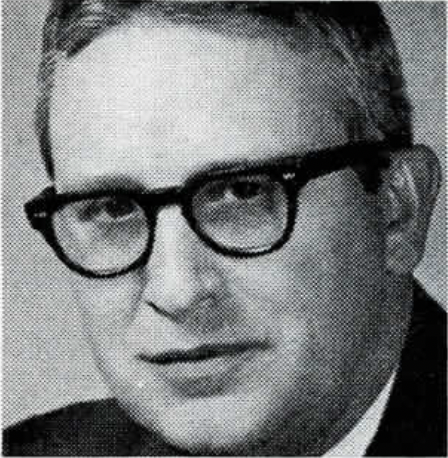

Baptist Scholar, Restoration Advocate, and Controversial Theologian
Robert Lee Shank was one of the most influential and controversial evangelical writers of the twentieth century on the subjects of perseverance, election, and the kingdom of God. Though ordained and long associated with the Baptist tradition, Shank became widely known among churches of Christ and Independent Christian Church circles because of his rejection of Calvinistic doctrines such as unconditional election and “once saved, always saved.” At the same time, his later advocacy of premillennialism led to sharp disagreement with many within those same circles. Throughout his life, however, Shank was regarded as a gracious, scholarly, and deeply committed student of Scripture.
Early Life and Education
Robert Lee Shank was born on May 8, 1918, in Claremore, Oklahoma. He grew up in Wichita, Kansas, where his father served for sixteen years as minister of the Immanuel Baptist Church. Raised in a religious environment, Shank developed an early interest in biblical study and Christian ministry.
He attended Ottawa University in Kansas, Southwest Baptist College, and William Jewell College in Missouri before graduating from Northeast Missouri State College. In 1941 he married Ruth Marybelle Sutton of Independence, Missouri. That same year he was ordained to the ministry, beginning a lifetime of preaching, teaching, writing, and lecturing.
Ministry Career
Shank spent more than sixty years in Christian ministry. He served Baptist congregations in Kansas and Missouri, including churches in La Harpe, Lebanon, Milan, Camdenton, Lake Ozark, Macks Creek, Branson, Louisburg, Billings, and Mount Vernon.
In addition to local church work, he taught for fourteen years at Faith Bible Academy in Camdenton, Missouri, serving seven years as its president. In addition to pastoral work, he taught for fourteen years at Faith Bible Academy in Camdenton, Missouri, and served as its president for seven years. He also became a widely traveled lecturer, speaking in churches, conferences, seminaries, and lectureships throughout the United States.
Although Baptist by background, Shank increasingly developed close associations with leaders in the Restoration Movement. He preached among the Baptists for twelve years. Then, for eight years he preached for the conservative Christian Church. Through the efforts of Marvin F. Bryant (1922-1997), he transitioned to the more conservative churches of Christ. During the 1970s, he frequently appeared on lectureships and evangelistic forums connected with churches of Christ. Reports in Restoration publications described him as devoting “much of his time in reaching denominational ministers with the restoration plea.” Calling their group, Restoration Leadership Ministry, Bryant, Shank and others were quite successful in their evangelistic pursuits.
In 1975 Pepperdine University awarded him an honorary doctorate in recognition of his scholarly and religious contributions.
“Life in the Son” and the Debate over Perseverance
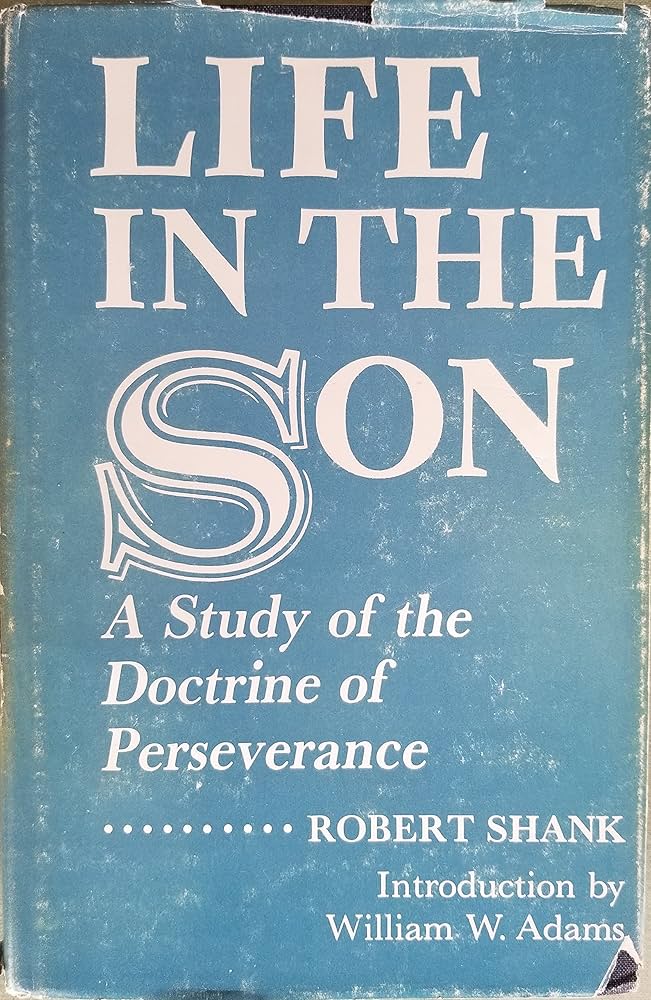
Shank first gained national prominence with his 1960 book Life in the Son: A Study in the Doctrine of Perseverance. The book directly challenged the Calvinist doctrine commonly summarized as “once saved, always saved.”
The book argued that salvation is genuinely secure in Christ, yet believers retain the ability to abandon their faith through unbelief and disobedience. Shank distinguished between the security of believers and the impossibility of apostasy. He insisted that Scripture repeatedly warns Christians against falling away and that these warnings are real rather than hypothetical. It sparked extensive discussion in evangelical circles. William W. Adams of Southern Baptist Theological Seminary wrote in the introduction: “I consider Life in the Son one of the most significant books in this generation.”
Many regarded the work as one of the strongest scholarly attacks on unconditional eternal security by a Baptist minister. The book went through numerous printings and reportedly sold more than 30,000 copies. Soon after its release, a review appeared in the Gospel Advocate. Guy N. Woods (1908-1993) wrote, "Robert Shank, a young Baptist minister of the Ozarks, and president of Faith Bible Academy, has produced what this reviewer believes to be the most important and significant book to appear from the denominational press in the last fifty years and which may well prove to be one of the greatest books ever written!" (GA, Nov. 3, 1960, p.695,96). By early 1962, the book was being advertised for sale through the Gospel Advocate (GA, Jan. 18, 1962, p.45).
Central themes in Life in the Son included: salvation by grace through faith; the necessity of obedient faith; the continuing nature of faithfulness; the real possibility of apostasy; and the believer’s security in Christ so long as faith remains living and active. Shank repeatedly emphasized that Christians are not saved by a past experience alone, but by an ongoing relationship with Christ.
“Elect in the Son” and the Doctrine of Election
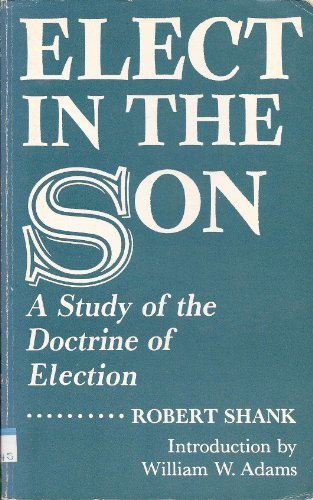
In 1970, Shank published another major theological work, Elect in the Son: A Study of the Doctrine of Election. In this volume he challenged Calvinist interpretations of predestination and unconditional election.
Shank argued that election is centered “in Christ” rather than in arbitrary divine selection of individuals before creation. He maintained: Salvation is potentially available to all men; Election is not unconditional; God’s chosen people are those united with Christ through faith.
The book became highly influential among Arminian and non-Calvinistic theologians. Restoration Movement writers commended it as a careful biblical response to Calvinism.
Relationship with the Restoration Movement
During the 1960s and 1970s, Shank became increasingly connected with churches of Christ and Restoration leaders. He spoke frequently at lectureships, forums, and evangelistic programs associated with those groups. In the September 23, 1971, issue of the Advocate, Marvin Bryant, director of Restoration Leadership Ministry, introduced Robert Shank as having "identified with the churches of Christ and is a member of the South National Church in Springfield, Mo." Along with this, a schedule of intended locations was included where he would "tell of his religious experiences following publications of his books" (GA, 09.23.1971, p. 605).
A 1973 report by Robert Shank noted his participation in the World Mission Forum at the Forest Park church of Christ in Atlanta, alongside former denominational ministers who had embraced Restoration principles. He also appeared at the Harding Lectureship and took part in evangelism clinics associated with David Lipscomb College.
By the late 1970s his enigmatic presence among different groups led to some newspaper advertisements describing him as “a Baptist minister” who had become a frequent speaker at events among churches of Christ nationwide. His books were widely used in theological colleges and seminaries across denominational lines. Many within churches of Christ appreciated his opposition to Calvinism and his willingness to debate major theological questions openly and courteously.
Debate over Premillennialism
Despite his acceptance in many Restoration circles, Shank later became controversial for defending premillennialism—the belief that Christ will establish a future thousand-year earthly reign following His return. His book "UNTIL: The Coming of Messiah and His Kingdom" advanced this position. In it, he argued that Old Testament kingdom prophecies await literal fulfillment in the future millennial reign of Christ. This position brought him into public disagreement with leading writers in churches of Christ, such as Bobby Duncan (1934-1999) and Wayne Jackson (1937-2020). Discussions with Jackson culminated in exchanges at the Denton Lectureship in Texas in November 1983. Hosted by the Pearl Street church of Christ, this debate clarified for many the eschatological interpretations of the Missouri preacher. Apologetics Press in Montgomery, Alabama, widely distributed the taped series through its paper, Reason And Revelation.
One particularly disputed issue concerning the relationship between the church and the kingdom. Jackson charged that Shank separated the church from the kingdom described in Matthew 16. Shank’s book stated: “The Church is not the kingdom of which Jesus spoke in Caesarea Philippi… but instead anticipates the coming of that kingdom at the end of the age.” This became a major point of contention among amillennial interpreters in churches of Christ.
In 1976, soon after Bobby Duncan became editor of Words of Truth, he reviewed Robert Shank's views on the future kingdom, as revealed in his book, God's Tomorrow. In response to opposing interpretations of 1 Corinthians 13:12, Duncan argued that if full knowledge does not come until we are face to face with the Lord, then we are still in the age of the miraculous, as detailed in verses 9-11. Duncan refuted that view. In August 1982, another article appeared attacking Shank's book, Until. Within a short time thereafter the Restoration Leadership Ministry severered ties with Shank. His last years were spent among the First Christian Church (Disciples of Christ) in Mount Vernon.
Final Years and Death
For forty-four years Robert and Ruth Shank lived in Mount Vernon, Missouri, where they raised their five children. On September 1, 2006, the couple celebrated their sixty-fifth wedding anniversary. Robert Lee Shank died peacefully on October 16, 2006, surrounded by his family. He was eighty-eight years old. He was survived by his wife Ruth Marybelle and their children: Walter Shank; Mary Aslin; David Shank; Martha Moore; and Carolyn King. He was also survived by grandchildren and great-grandchildren. His funeral was held at the First Christian Church (Disciples of Christ) in Mount Vernon, Missouri and burial followed in the Mt. Vernon Cemetery. Ruth lived for ten more years, and passed away May 16, 2016, ten years to the day before this webpage was produced.
Legacy
Robert Lee Shank occupies a unique place in twentieth-century American theology. A Baptist minister who challenged Calvinism, a scholar who valued and defended the Restoration Plea, and later was set at odds with his amillennial brethren over his premillennial views, Shank remained throughout his life an independent biblical student. His books Life in the Son and Elect in the Son continue to be cited in discussions concerning perseverance, apostasy, grace, election, and free will. Though readers often disagreed with him on significant points, few denied his sincerity, scholarship, or profound influence on modern theology.
-Scott Harp, 05.16.2026
Newspaper Advertisements
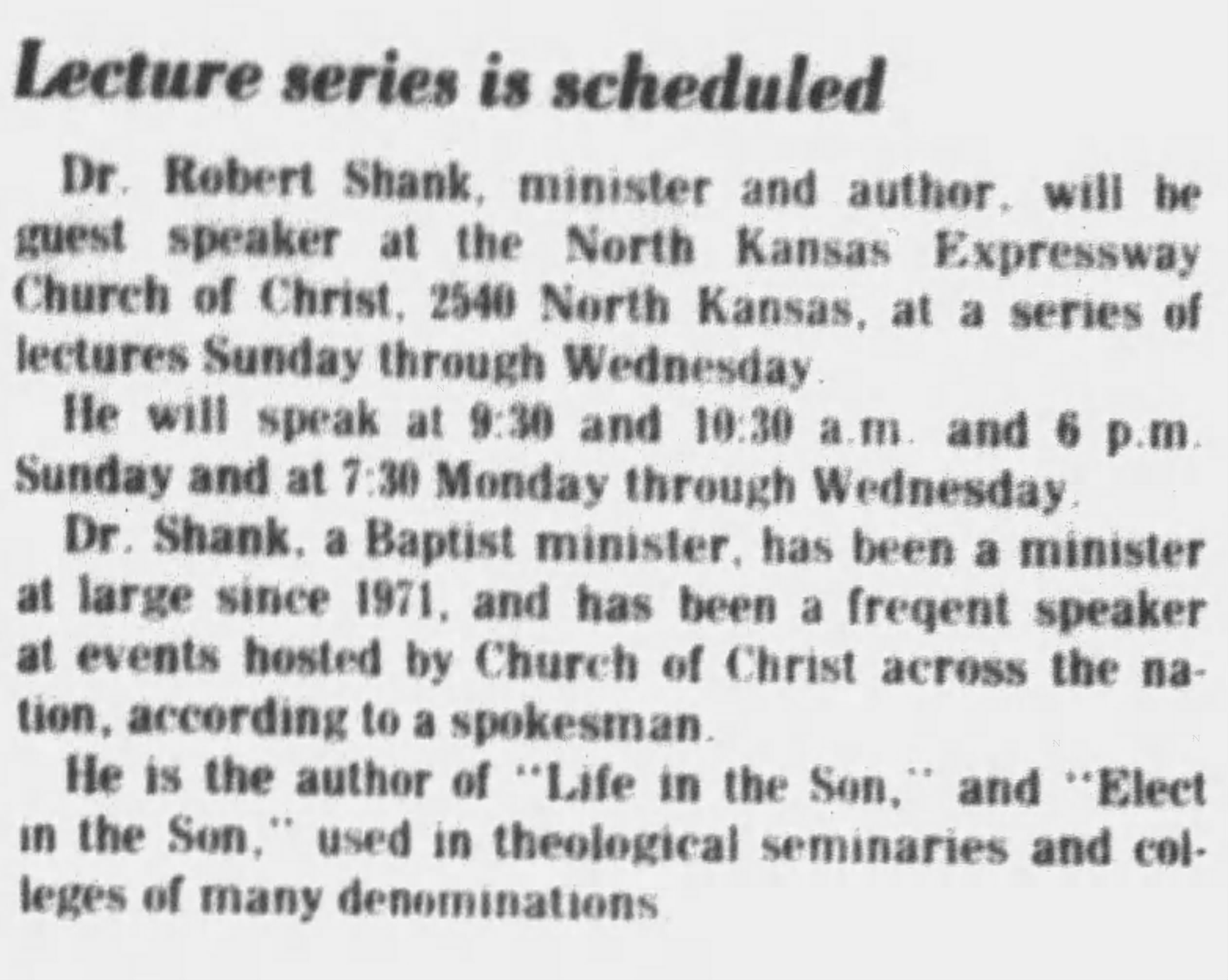
Springfield Leader and Press, Springfield, Missouri
October 14, 1978, p.7
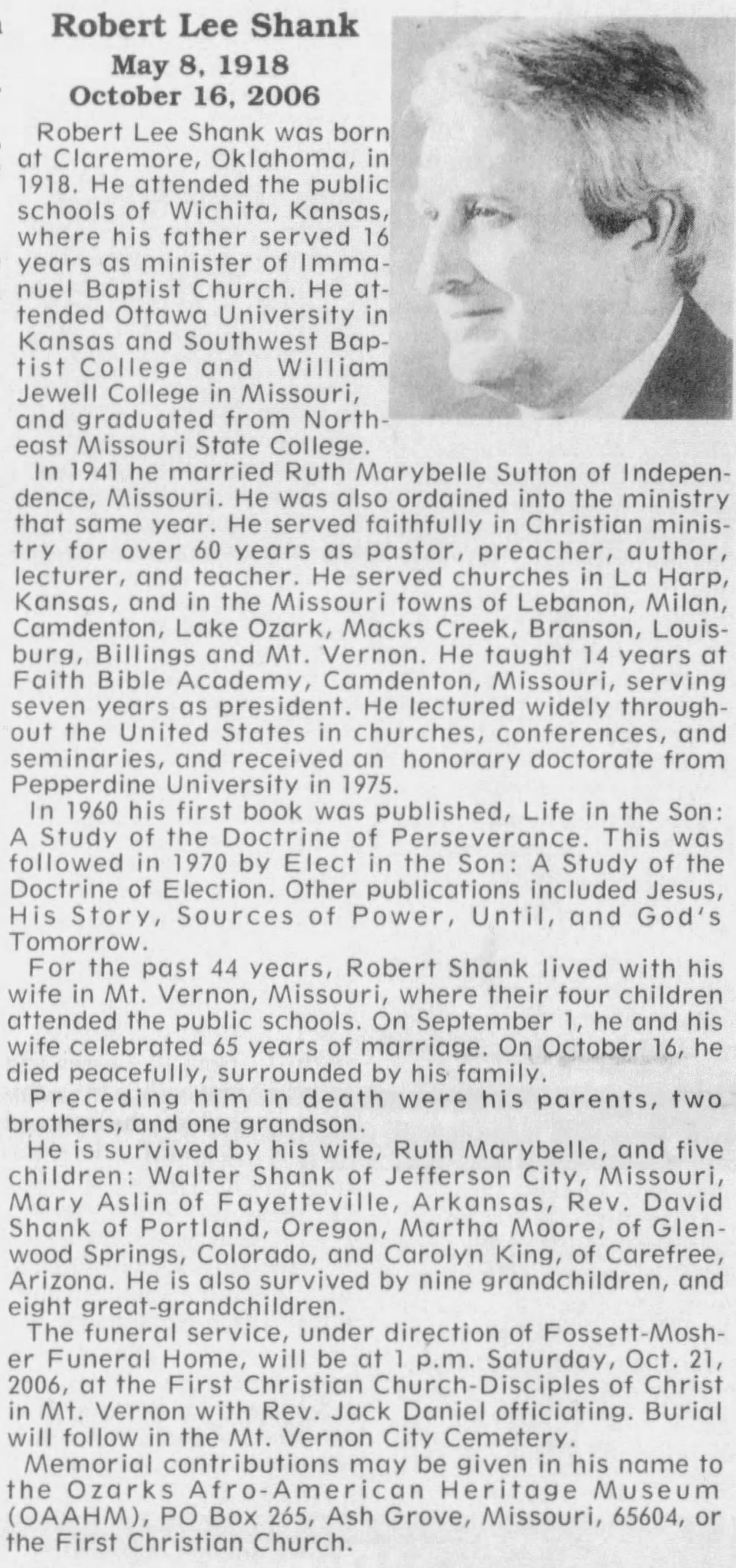
The Springfield News Leader, Springfield, Missouri
October 20, 2006, p.14
Directions To Grave
Robert and Ruth Shank are buried in the Mt. Vernon Cemetery in Mt. Vernon, Missouri. Mt. Vernon is located in SW Missouri between Springfield and Joplin. From Springfield take I-44. Take the E. Mt. Vernon Blvd. Turn right on S. McCanse St. Stay on this road north until road becomes N. McCanse St. Keep going until you will see the cemetery on the left where N. McCanse St. intersects with Valley View Dr. Enter cemetery, and head down about halfway of the little road in the cemetery. The Shank plot will be to your right. See photos below. GPS below is actual location of the Shank family plot in the cemetery.
GPS Location
37°06'19.6"N 93°48'59.6"W
or D.d. 37.105439,-93.816567
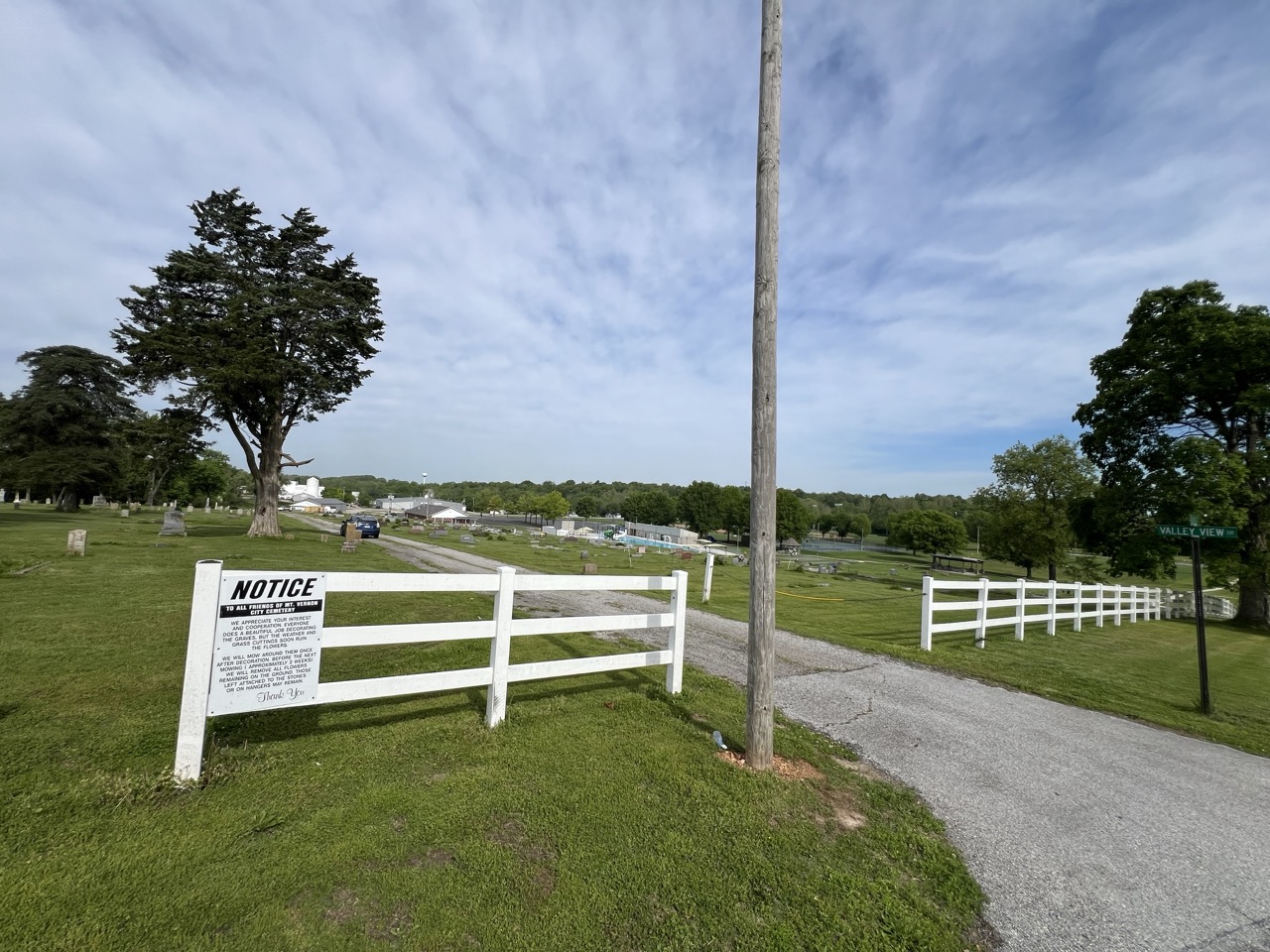
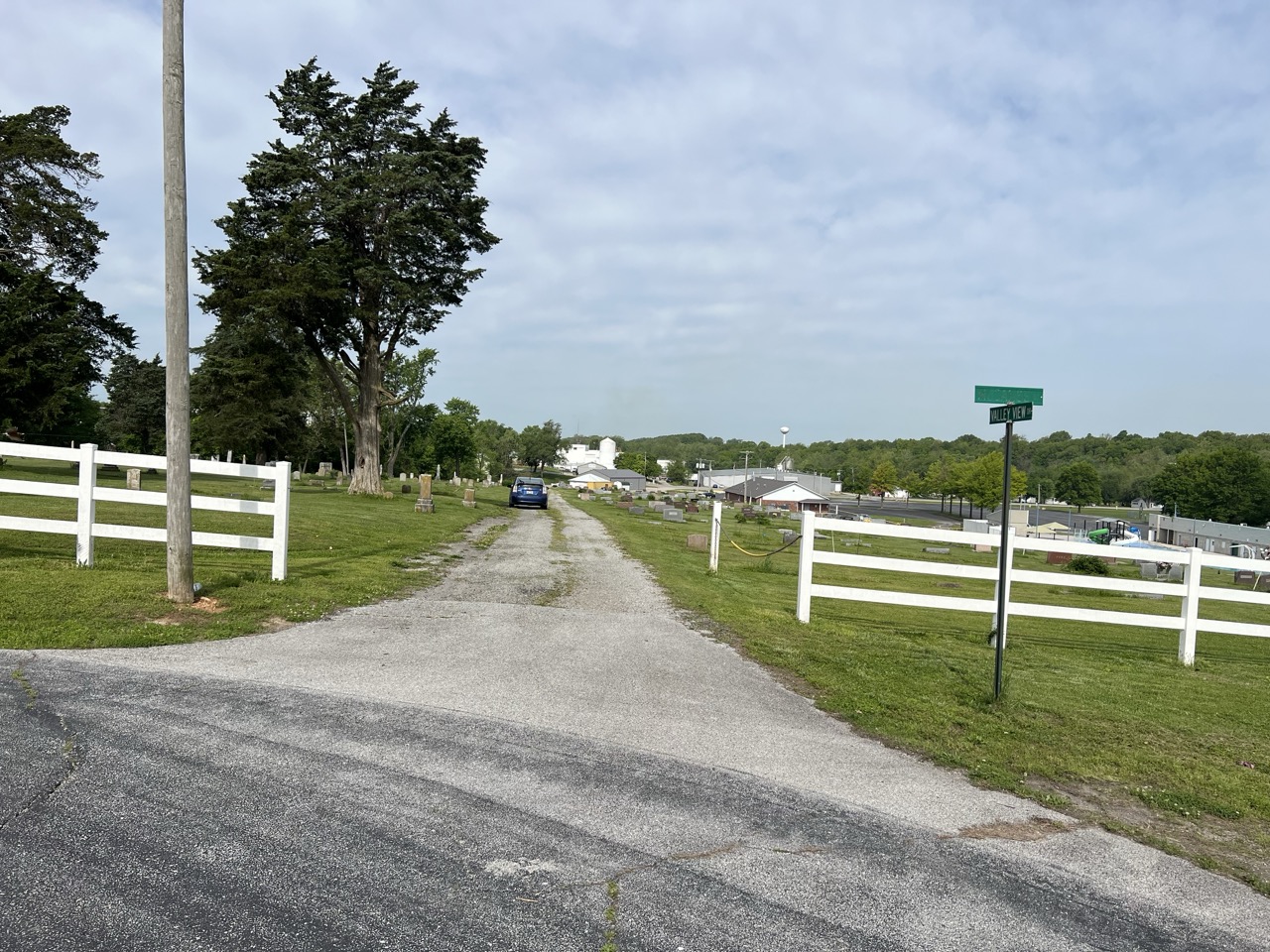
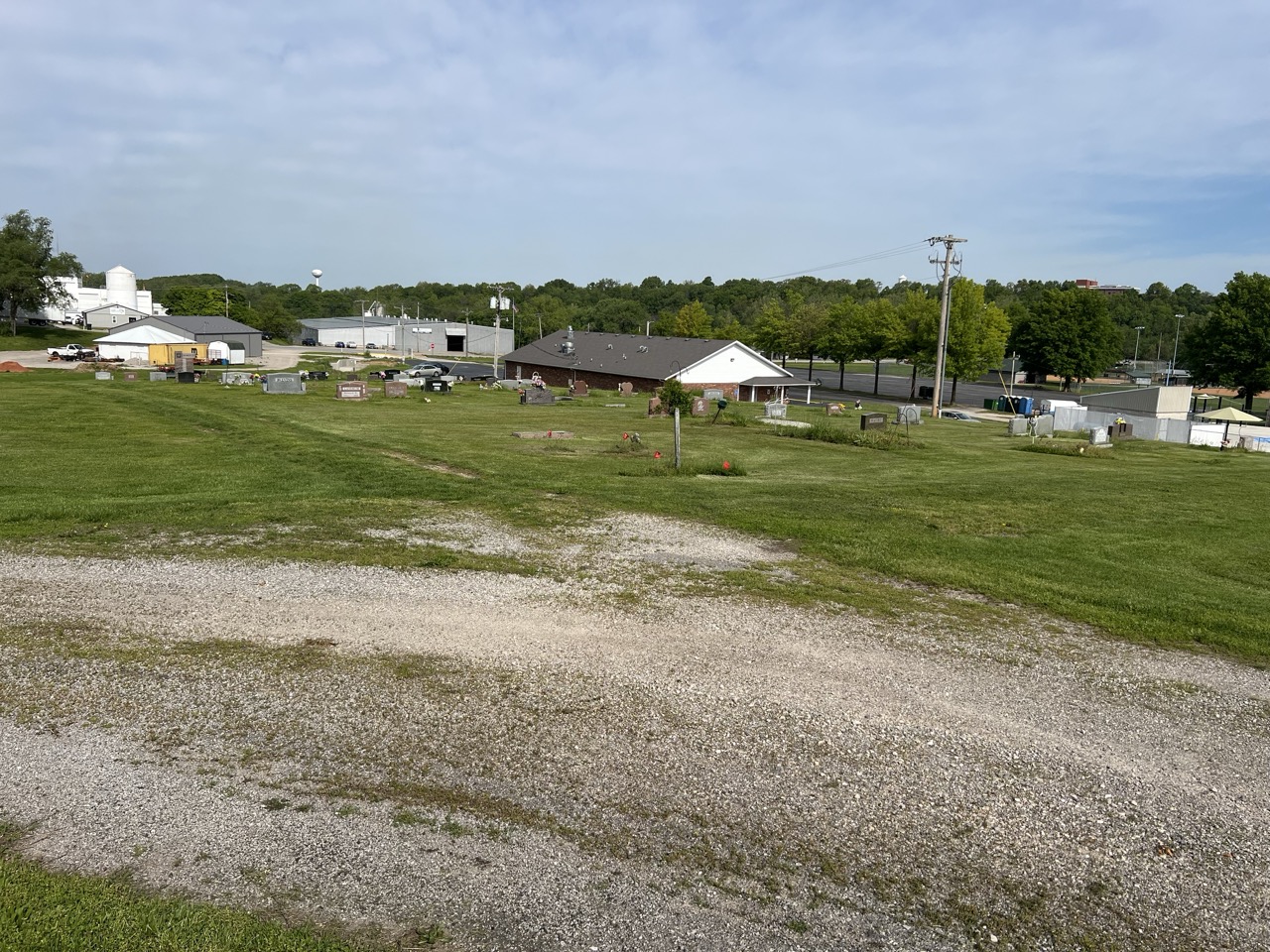
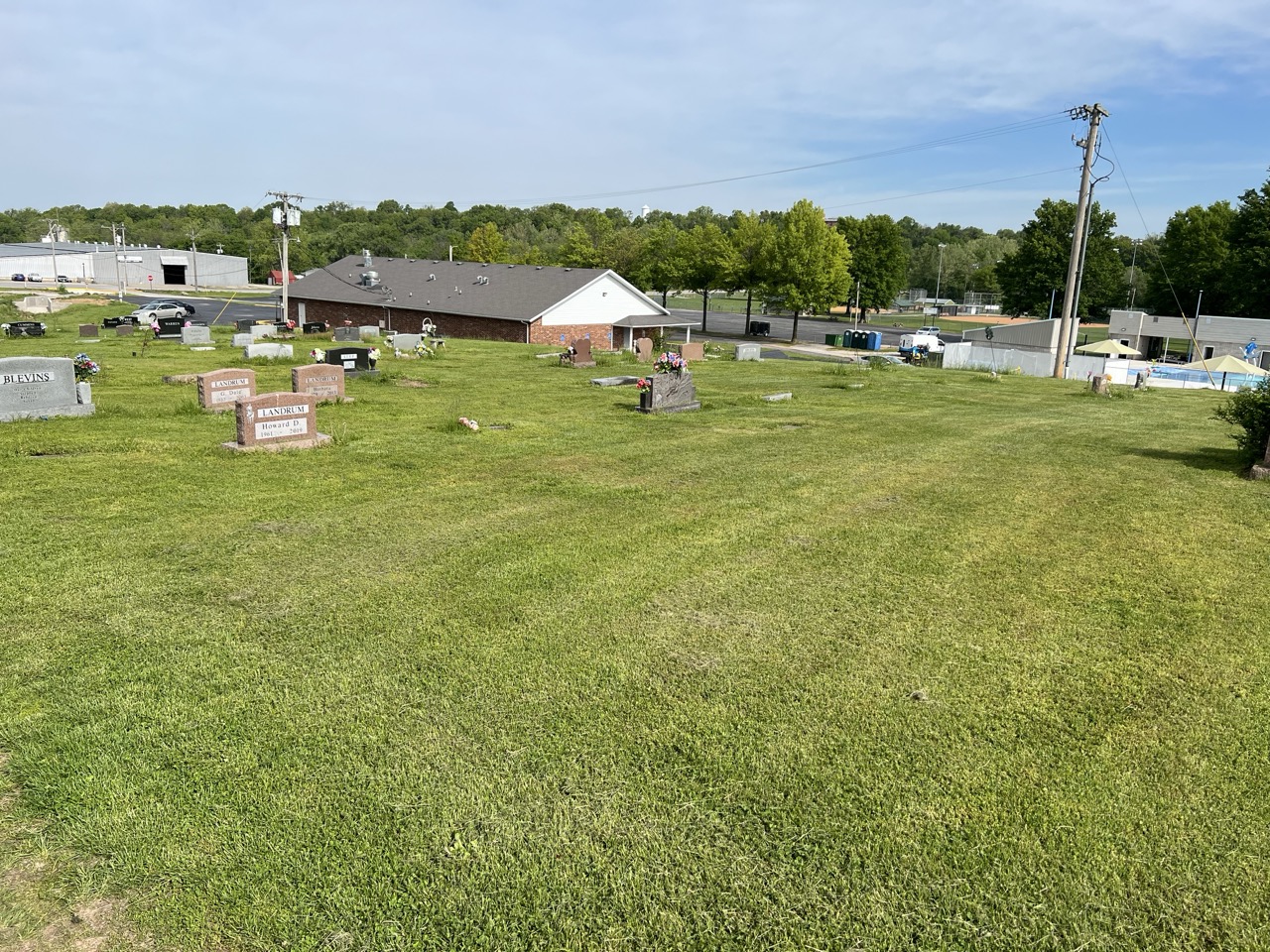
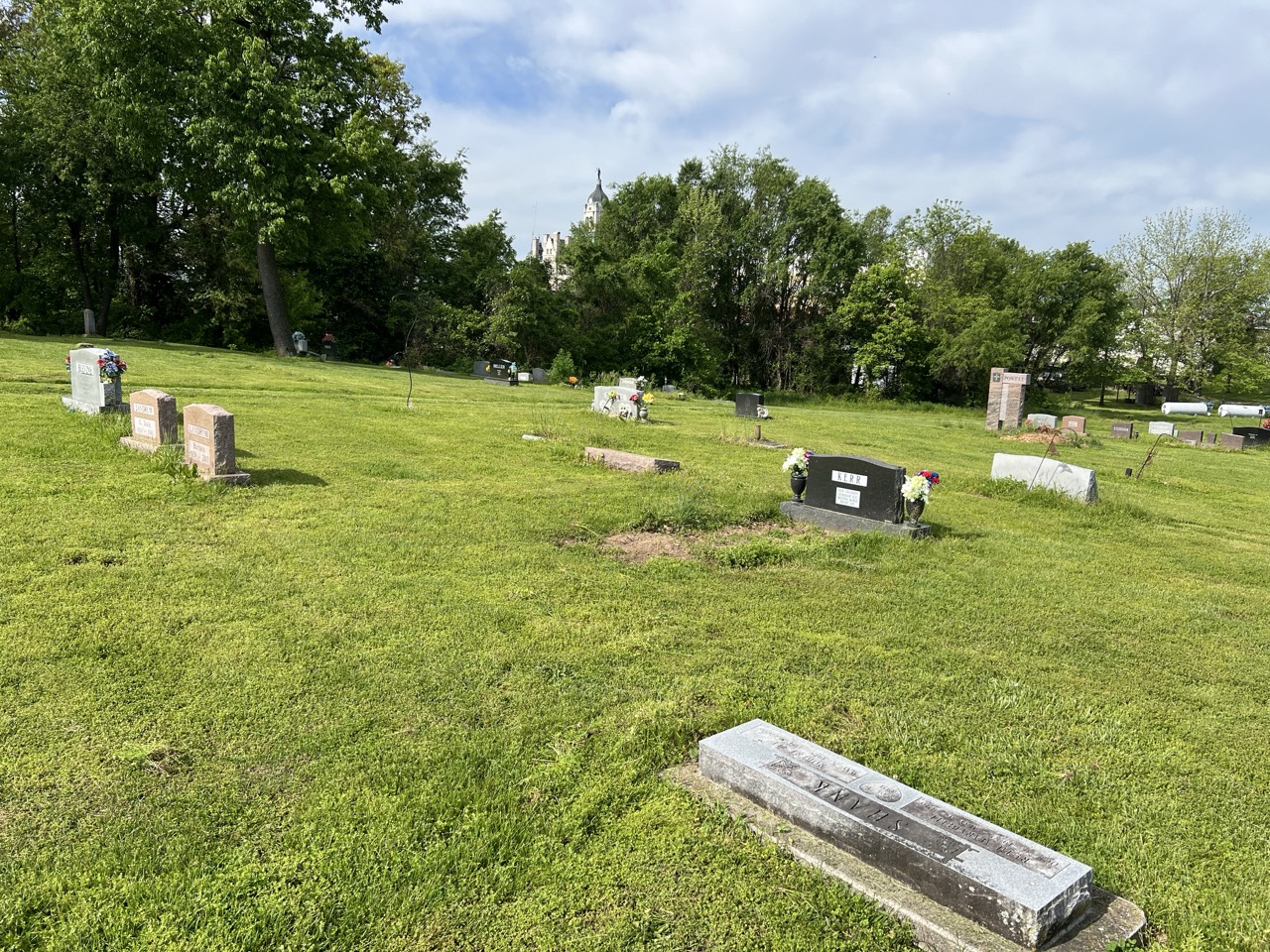
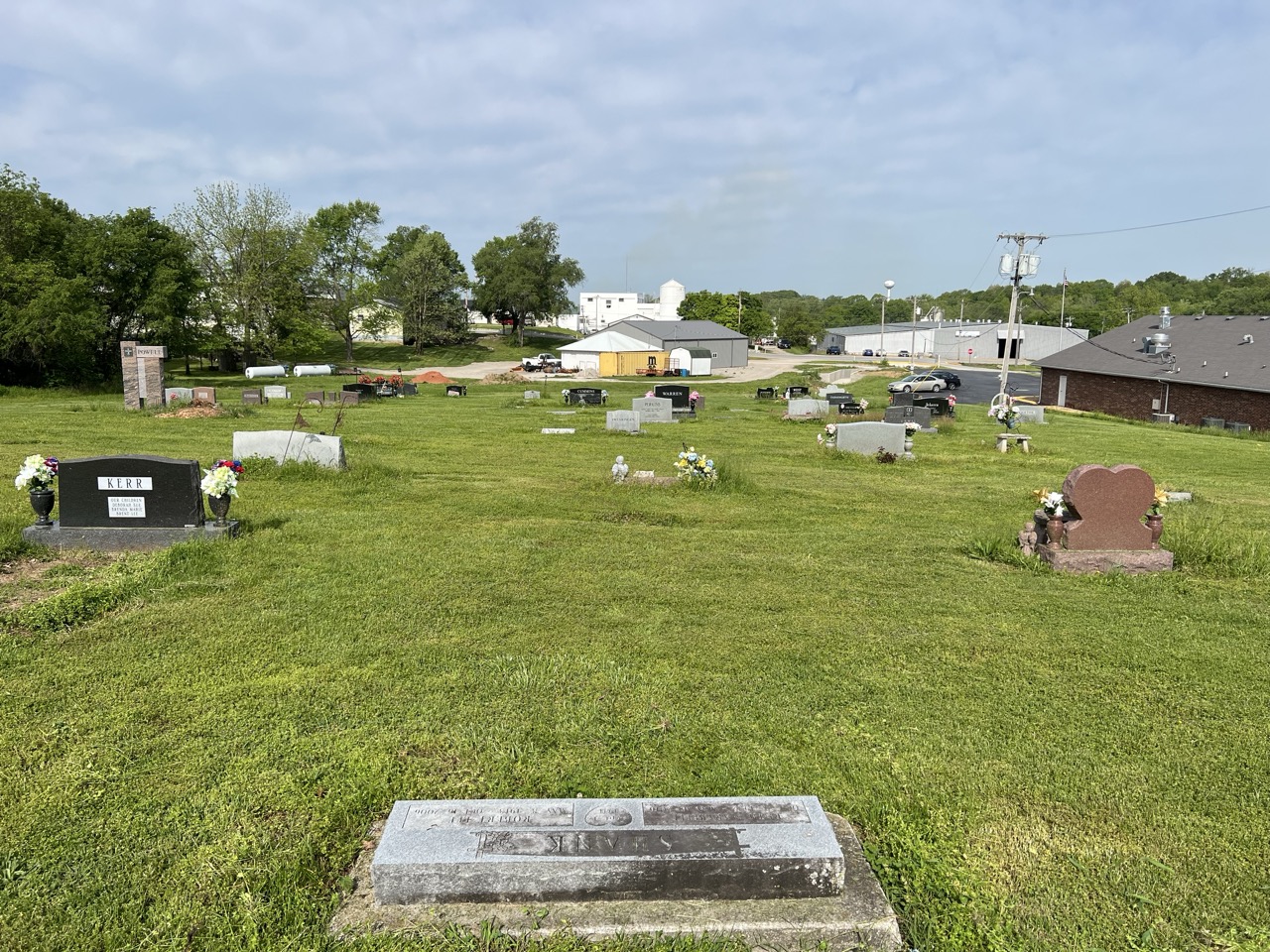
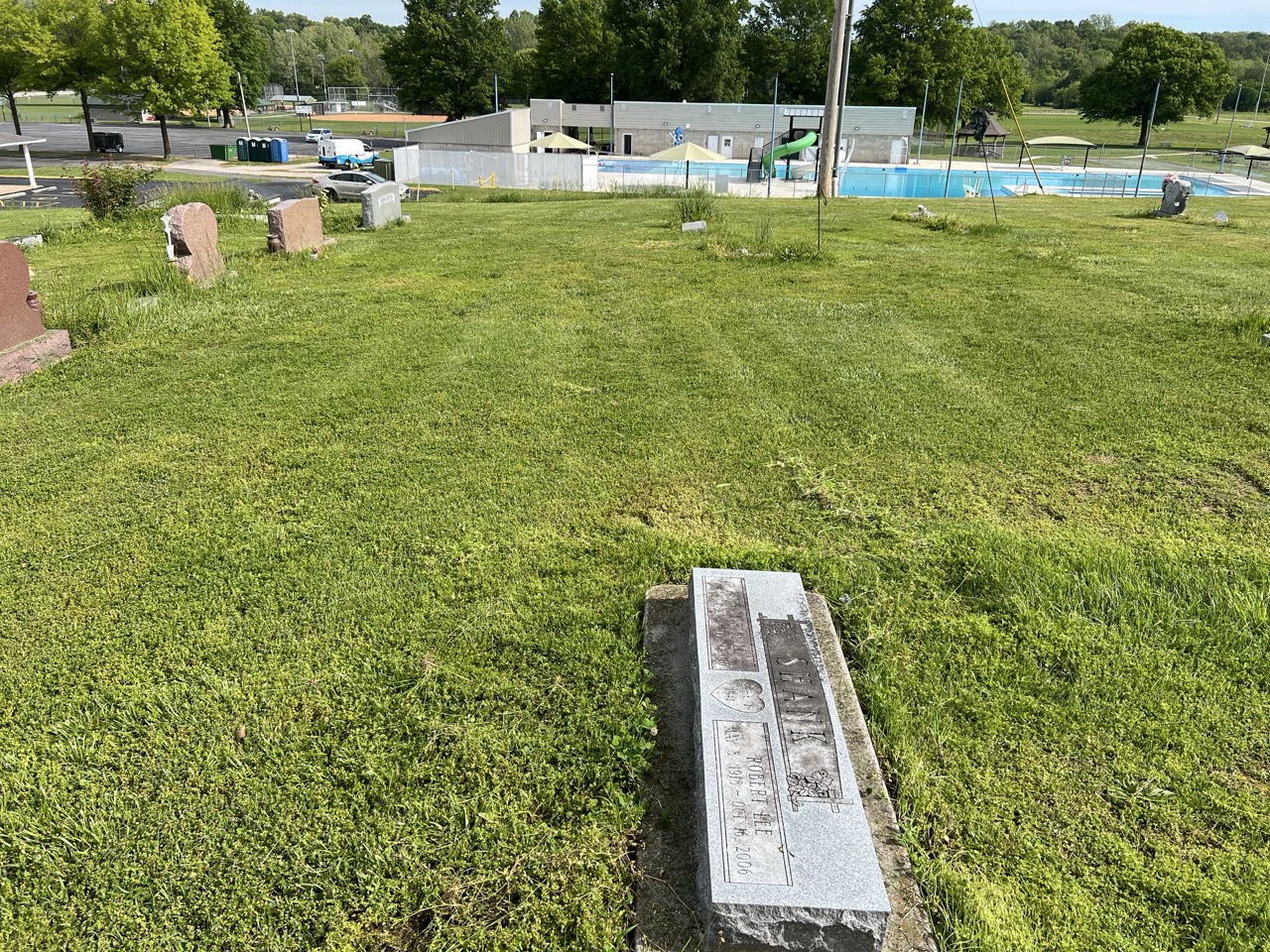
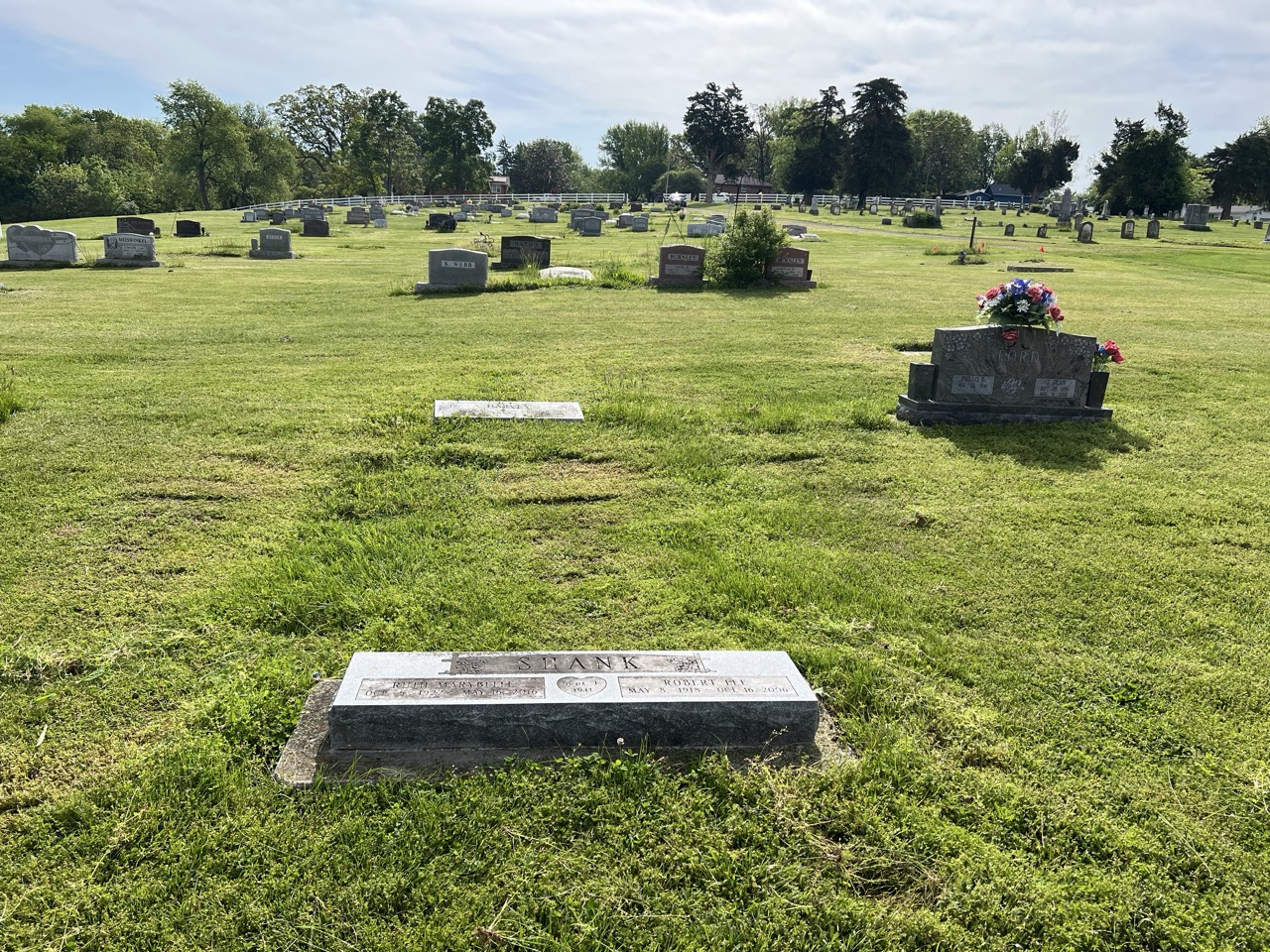
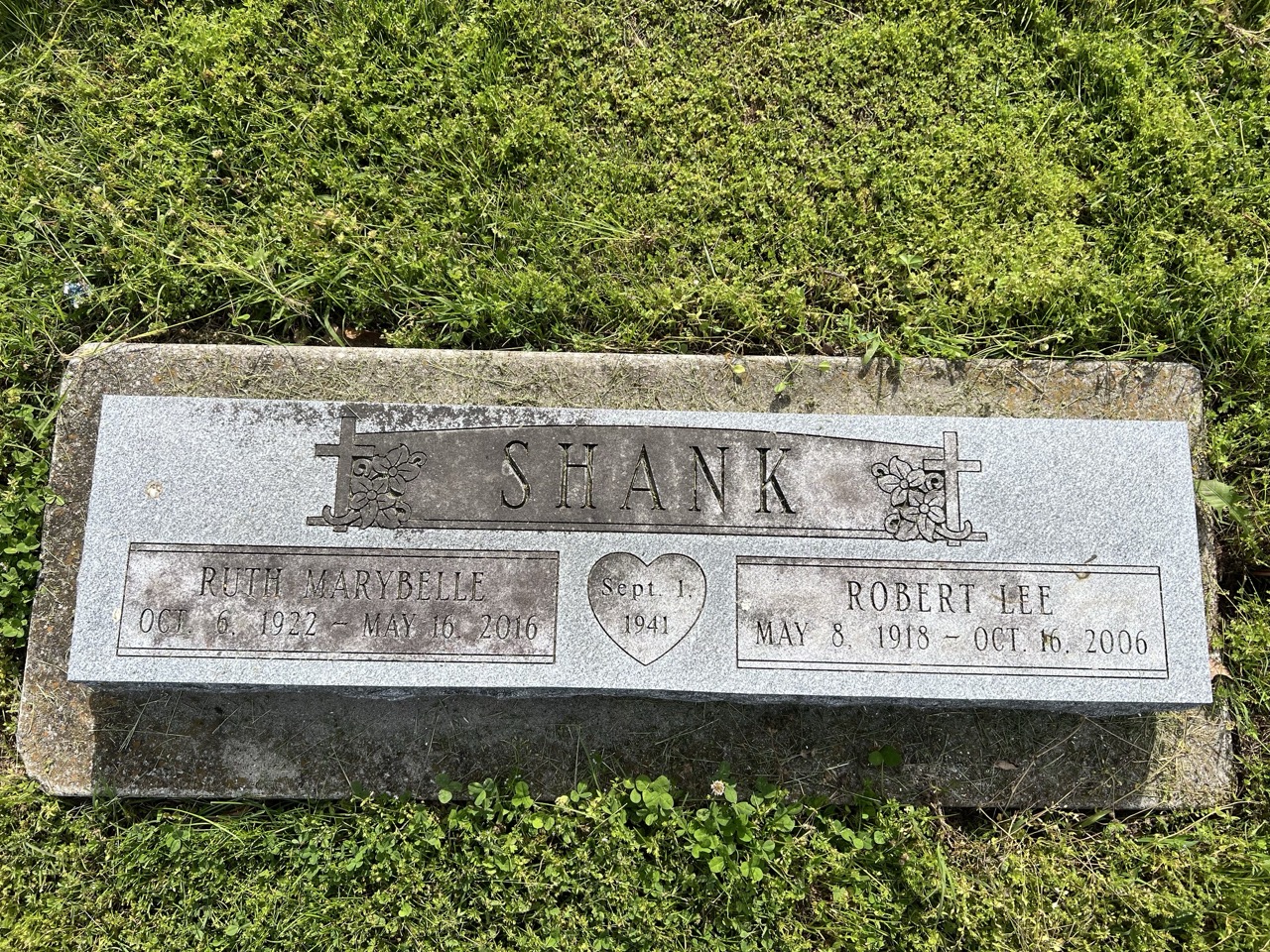
SHANK
Ruth Marybelle - October 6, 1922 - May 16, 2016
Robert Lee - May 8, 1918 - October 16, 2006
Married September 1, 1941
Photos Taken May 6, 2025
Webpage Produced May 16, 2026
Courtesy Of Scott Harp
www.TheRestorationMovement.com
Special Recognition: I've heard the name of Robert Shank all my life. It was a blessing to finally visit his grave while involved in a gospel meeting in Lebanon, Missouri in May 2025.